From Herds to Fish: Bomet Embraces Aquaculture for a Resilient Future

Governor Prof Hillary Barchok (right), KALRO Oljororok Centre Director Mr Mathai Ndung'u (left) and Climate Change Chief Officer Solomon Kimetto (Second left) hand over fingerlings to Emmaus Community Based Organization. Photo/ Kipyegon Chirchir

By Kipyegon Chirchir
Published on November 19, 2025
In the undulating highlands of Bomet County, where the rhythmic lowing of cattle has long been the soundtrack to life, a quiet revolution is taking root.
For generations, the community's identity and prosperity have been inextricably linked to livestock rearing, a tradition so deeply ingrained that the idea of fish as a primary source of sustenance or income was often met with skepticism, even disdain.
Yet, today, in a remarkable pivot towards climate resilience and diversified livelihoods, Bomet is charting a new course, constructing 25 fishponds – one in every ward – under the Financing Locally Led Climate Action (FLLoCA) program Cycle -1.
The initiative is not merely about introducing a new food source; it's a transformative journey aimed at fortifying household incomes, bolstering food and nutrition security, and fostering a more sustainable relationship with the land in the face of a changing climate.
For decades, the livestock and agrarian communities of Bomet have weathered the vagaries of climate change, from increasingly erratic rainfall patterns to prolonged droughts that devastate pastures and decimate crops.
The community’s reliance on traditional livestock farming, while culturally significant and economically foundational, has exposed them to significant vulnerabilities.
Sentiments echoed by Governor Prof. Hillary Barchok during the launch of stocking of fingerlings in Emmaus Community Based Organization FLLoCA funded fish pond, in Chemagel Ward Sotik Sub-county, to mark the roll out of stocking of the fish ponds constructed so far.
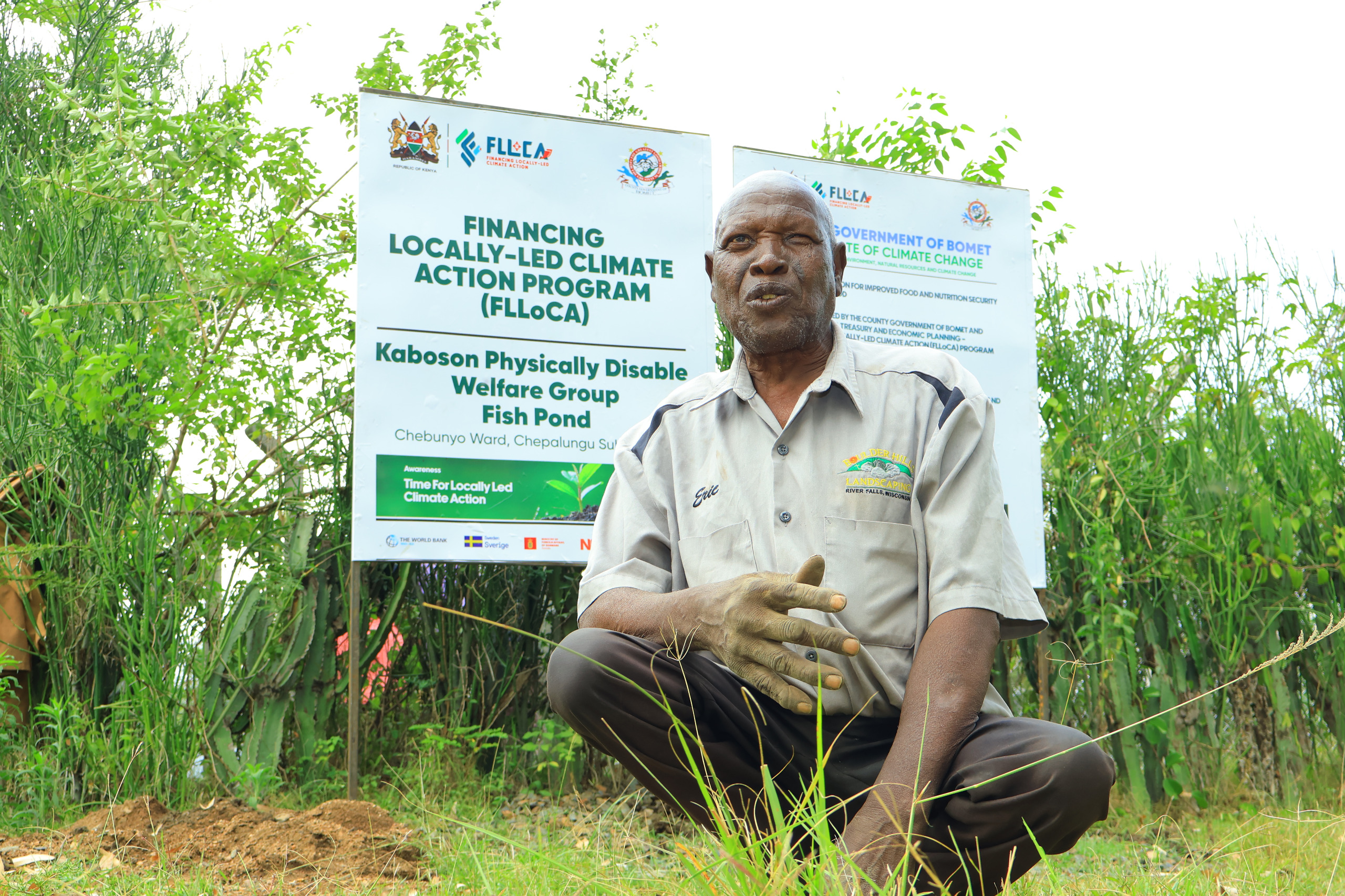
Mr Samwel Chepkwony, Chairman of 120-member Kaboson Physically Disabled Welfare Group in Chebunyo Ward, in Chepalungu sub-county. Photo/ Kipyegon Chirchir
Christopher Ng’eno, the Chairman of the 109-member Emmaus Community Based Organization (CBO), a beneficiary of the FLLoCA-funded fish farming group, shared, "Fish farming was initially frowned at owing to the community’s traditions and believes,”
However, “with the effects of climate change in the region, the community has adopted it as an alternative source of livelihood, creating employment opportunities and also eased access to food. The neighborhood can now access fish nearby, unlike before when we had to travel to town to get it."
The paradigm shift began with the advent of the FLLoCA program. A flagship initiative of the Kenyan government, supported by partners like the World Bank, FLLoCA is designed to empower local communities to take ownership of climate adaptation and mitigation strategies.
Organized into groups, registered beneficiaries across the county have undergone intensive training sessions, focusing on modern fish farming techniques, pond management and sustainable aquaculture practices.
Governor Prof. Barchok, emphasized building resilience and enabling economic empowerment within communities through the FLLoCA program for them to embrace environmental conservation thus mitigating climate change.
Governor Barchok stressed that environmental conservation goes beyond regulations. "We have to move away from the belief that it is the laws and regulations that will help conserve the environment; rather, we are creating an enabling environment by introducing friendly economic activities within the community for them to benefit from the conservation activities."
"Through FLLoCA, we are exploring technologies within our people to build resilience towards climate change by ensuring our people are economically enabled through interventions including fish farming," Governor Barchok stated.
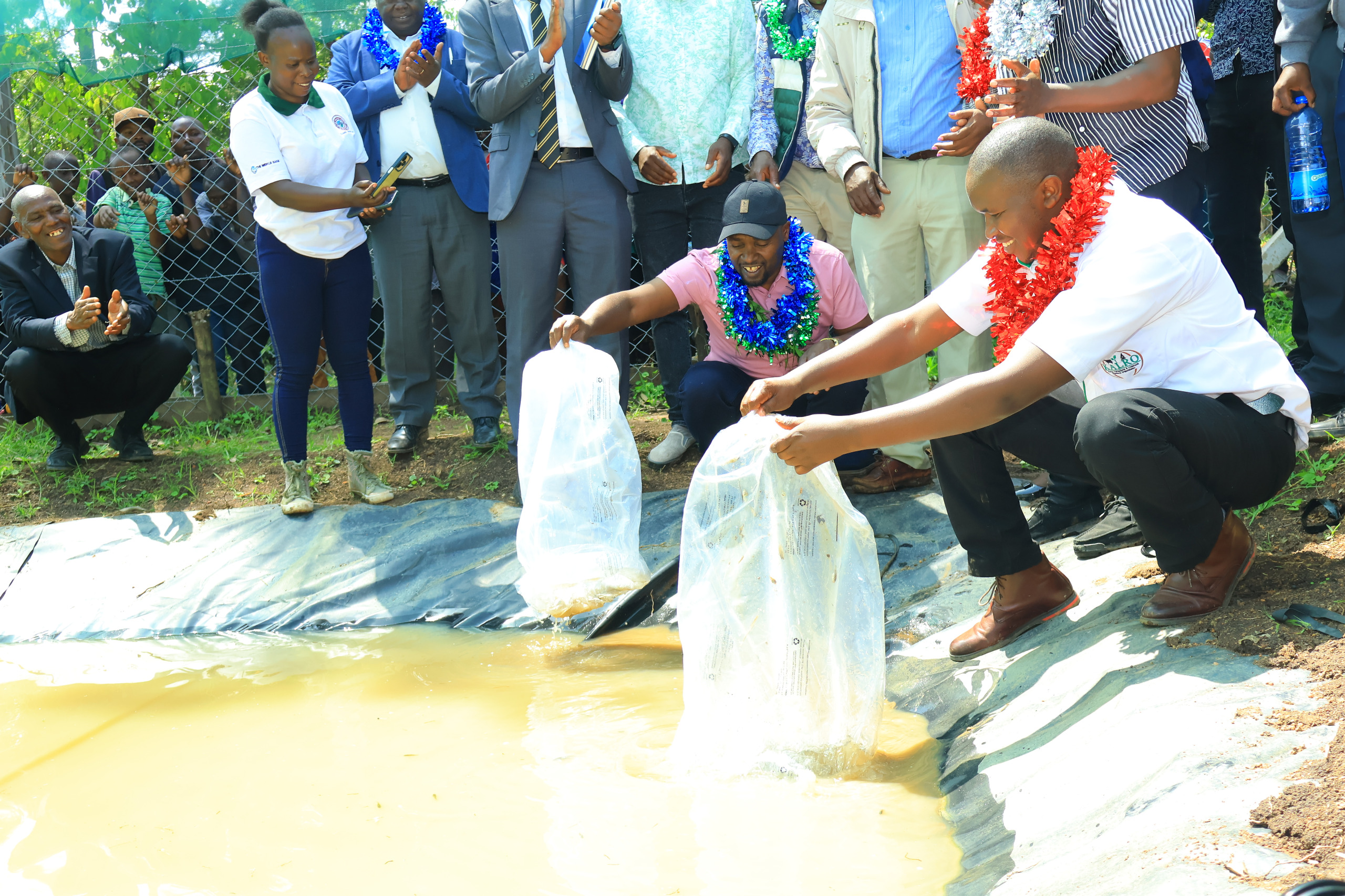
Governor Prof. Hillary Barchok, with a KALRO fisheries officer, placing the fingerlings in the pond during the launch of the stocking of the FLLoCA-funded fish ponds in the county at Emmaus CBO fish pond. Photo/ Kipyegon Chirchir
Adding, “past cultural perceptions against fish farming and consumption but noted a significant shift driven by increased awareness of fish's nutritional benefits and economic opportunities.”
The 25 fish ponds, measuring approximately 300 square meters, are stocked with 1000 high quality male Nile tilapia fingerlings, sourced from Kenya Agricultural and Livestock Research Organization (KALRO).
Also, the groups are supplied with seasonal fish feeds and a fisheries officer to provide technical support on the implementation of the projects and at the time. Thereafter the farmers, through their business plan and sustainability efforts will restock the ponds themselves.
"Recognizing Biomet’s unique challenges and its untapped potential, the program identified aquaculture as a potent, multi-faceted solution. FLLoCA is about localized solutions for global challenges," explains Solomon Kimetto, Chief Officer for Water, Environment, Natural Resources, and Climate Change.

Fisheries Officer Victoria Mulama with Ng'ainet Visionary Youth Group, a youth fish farming group in Ndarawetta ward, during pond site visit on extension services. Photo/ Kipyegon Chirchir
To bolster the shift to fish farming, Bomet in partnership with Kenya Agricultural and Livestock Research Organization (KALRO), considering their expertise and technologies, is establishing a state-of-the-art fingerling production unit and fish feeds to serve the growing numbers of fish farmers in the county and the region.
The new unit will localize supply, significantly boosting profit margins for Bomet’s growing number of fish farmers.
Currently, local farmers must source feeds from distant counties like Homabay, Siaya, and Kisumu, which increases production costs.
He added, "We conducted extensive participatory climate risk assessments across the wards. The community's vulnerability, particularly regarding food security and income stability during droughts, was evident. Fish farming emerged as a highly adaptable and climate-resilient intervention."
“To ensure sustainability and self-reliance, Bomet is tackling the logistics of the supply chain head-on. A fish farmers training centre is being established in Bomet Town to provide continuous capacity building.” Fisheries Officer Victoria Mulama pointed out.
She added, “The curriculum focuses on maximizing production output and equipping farmers with the skills to develop robust business plans, treating aquaculture as a viable commercial enterprise.”

National Treasury Project Implementation Unit with Bomet County Climate Change Unit officials during a vistto Ngainet Visionary Youth Group Fishpond on a project inspection mision of FLLoCA funded projects. Photo/ Kipyegon Chirchir
By integrating production, seed supply, and education, Bomet is poised to rewrite its agricultural narrative, proving that the highlands can indeed feed the region with fish.
Janet Tonui, the Secretary of the Emmaus CBO, expressed gratitude for the fish farming project's impact on nutrition. "We are grateful for the project; it will boost our nutritional value, specifically for young children. We no longer rely on fish from outside the county; we have our home-bred."
“Besides creating employment, land utilization, creating resilience in climate change and providing alternative sources of livelihood, we, the youth, are taking the group's fish pond as a model design for us to replicate in our individual farms thus creating more impact in our community.” Caleb Langat, Emmaus CBO member said.
Other notable FLLoCA funded fish farming groups are Toret Moi Women Group, a widow’s group in Siongiroi ward and Kaboson Physically Disabled Welfare Group in Chebunyo Ward of Chepalungu sub-county.
By integrating production, seed supply, and education, Bomet is poised to rewrite its agricultural narrative, proving that the highlands can indeed feed the region with fish.

Bomet County Assembly Public Accounts Committee visit to Emmaus CBO Fishpond in Chemagel ward in an oversight tour. Photo/ Kipyegon Chirchir
Comments Below