Jubilee Party is heading into a critical internal transition after Deputy Party Leader Jeremiah Kioni resigned following 11 years in the outfit, just days before the party convenes its delegates to consider changes to its national leadership and constitution.
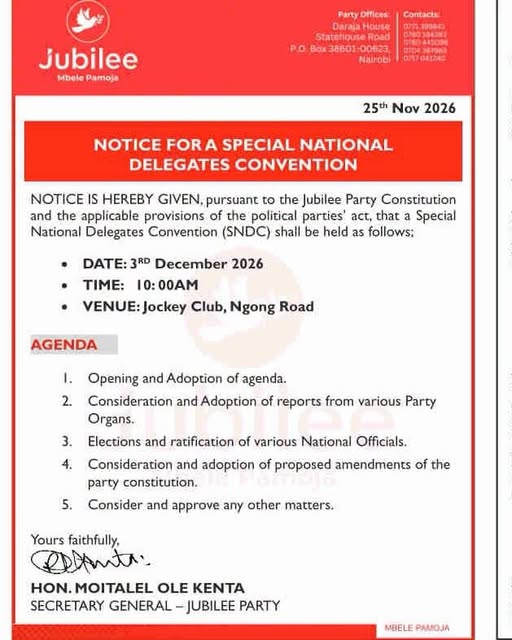
Kioni’s resignation, announced on Wednesday, November 25, 2026, coincided with a notice summoning members to a Special National Delegates Convention (SNDC) on December 3, setting the stage for two significant developments in the former ruling party’s reorganisation ahead of the 2027 General Election.
The convention, scheduled for 10:00AM at the Jockey Club along Ngong Road in Nairobi, will consider reports from various party organs, elect and ratify national officials and deliberate on proposed amendments to the Jubilee Party Constitution.
“NOTICE IS HEREBY GIVEN, pursuant to the Jubilee Party Constitution and the applicable provisions of the Political Parties Act, that a Special National Delegates Convention (SNDC) shall be held as follows,” the notice stated.
The timing of the meeting places Kioni’s departure against a broader moment of organisational change, with Jubilee preparing to make decisions that could influence its leadership arrangements and political strategy.
Kioni signals political realignment
In a resignation letter addressed to Acting Party Leader Fred Matiang’i, Kioni said his departure was effective immediately, describing his 11-year association with Jubilee as a defining chapter that had shaped his political career.
“It has been eleven years, a long road, a defining one, and one I would walk again,” he wrote.
He recalled serving as Secretary General for four years before taking up the position of Deputy Party Leader for almost one year, thanking former President Uhuru Kenyatta for the trust and leadership extended to him.
Kioni also paid tribute to Jubilee members, county officials, Secretariat staff and the National Executive Committee, describing the party as a collective institution built through the contribution of many people.
However, his departure was accompanied by a declaration that he intended to remain politically active.
“My departure is not a farewell to public life, nor the end of my political journey,” he stated.
He disclosed that he was preparing to launch another political platform, but did not reveal its name, leadership, ideological direction or intended political alliances.
The announcement introduces a new dimension to the political positioning ahead of 2027, particularly as former Jubilee officials and other political actors explore different formations.
Matiang’i faces crucial party decisions
Kioni’s resignation also comes as Matiang’i assumes the responsibility of leading Jubilee, with the December convention expected to provide a platform for delegates to consider the party’s next organisational steps.
In his farewell message, Kioni wished Matiang’i well, urging him to lead with wisdom, courage and unity of purpose.
He also expressed hope that the former Interior Cabinet Secretary’s presidential campaign would be strong, disciplined and inspiring.
These decisions could help define the party’s leadership structure and internal governance as it prepares for the next electoral cycle.
However, Jubilee has not indicated that the convention was convened because of Kioni’s resignation, and the two developments should be understood as separate events unfolding during the party’s transition.
A new chapter ahead of 2027
For Kioni, the immediate question is what form his proposed political platform will take and which leaders he intends to work with.
His resignation letter offers little detail beyond his intention to carry forward the friendships, lessons and political convictions developed during his time in Jubilee.
For the party, the immediate test will be maintaining organisational cohesion while delegates deliberate on leadership and constitutional changes.
The December 3 convention will therefore be an important marker in Jubilee’s preparations for 2027, while Kioni’s next move could introduce another political formation into an already shifting landscape.
“The work of building a better Kenya continues,” Kioni said in his closing message, making clear that his departure from Jubilee is not an exit from politics.