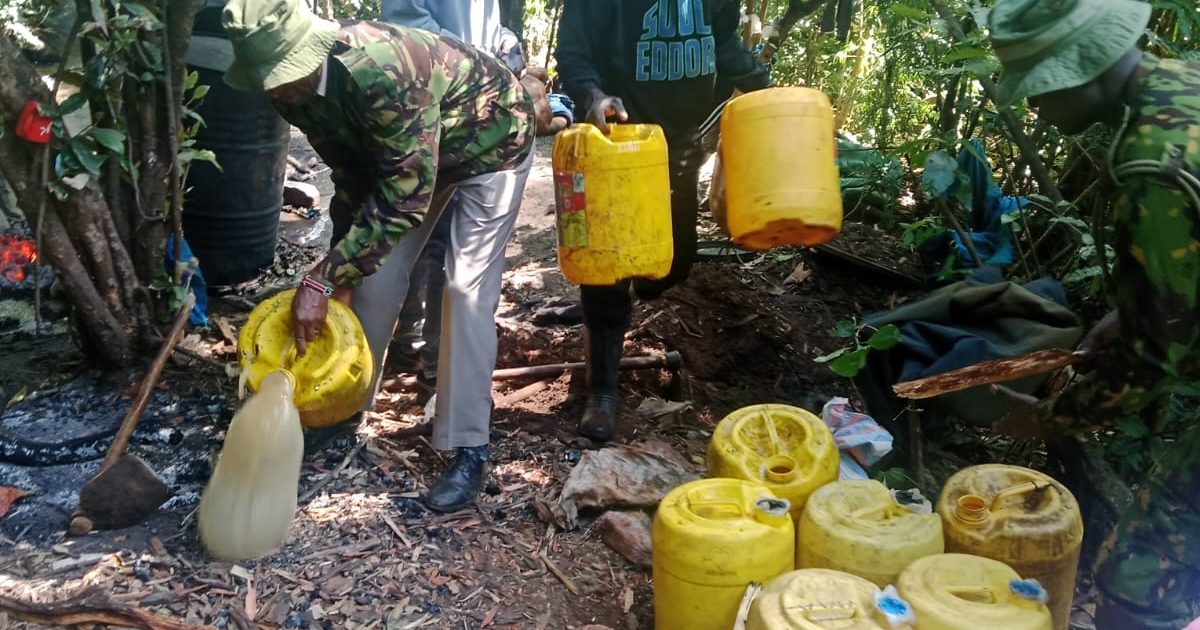
LAIKIPIA, Kenya — Authorities in Laikipia County have intensified their crackdown on illicit alcohol, destroying more than 2,600 liters of kangara and seizing 160 liters of chang’aa during a multi-agency operation in Shamanek village, Nyahururu Sub-County.
The joint operation, which brought together security agencies and local administrators, targeted illegal brewing dens as part of sustained government efforts to curb the production and distribution of harmful, unregulated alcoholic drinks.
Laikipia County Commander Peter Nduriri warned that the government will maintain the momentum until the illicit brew menace is completely eradicated from the region.
“The locals should be informed that illicit brews are not permitted in Laikipia. We will continue pursuing those involved in the illegal production and sale of these dangerous substances,” Nduriri said.
He emphasized that the ongoing raids are primarily aimed at protecting public health and enhancing community safety by eliminating lethal substances from circulation.
Socio-Economic Toll
Beyond the immediate legal violations, authorities expressed deep concern over the devastating impact of alcoholism on local families and education. Nduriri noted that many children are forced to drop out of school due to financial neglect and unstable home environments caused by addiction.
“Resources that should be used for school fees and basic needs are often diverted to alcohol, leaving children vulnerable,” the County Commander added.
Local residents welcomed the security operation, noting that the proliferation of illegal brewing dens has fueled rising crime rates, domestic violence, and deepening poverty in the area.
The Shamanek raid comes amid a wider, regional concern over the socio-economic effects of illicit alcohol across Central Kenya. In recent years, unregulated brews have been linked to numerous deaths, blindness, family breakdowns, and declining economic productivity.
National agencies, including the National Authority for the Campaign Against Alcohol and Drug Abuse (NACADA), are continuing to advocate for a dual approach—combining strict law enforcement with accessible rehabilitation programs—to permanently address the crisis.