
The East Africa Law Society (EALS) has raised concerns over President William Ruto’s directive targeting foreign nationals engaged in small-scale trading, hawking and related commercial activities in Kenya, warning that its implementation must comply with the country’s regional obligations under the East African Community (EAC).
In a statement issued on Monday, September 7, 2026, EALS said it was particularly concerned about anxiety among Burundian and other EAC citizens in Kenya following the directive.
The regional lawyers’ body noted that a large number of Burundian nationals had recently sought consular assistance and documentation in Nairobi, saying the developments required careful attention because enforcement measures could affect livelihoods, personal security, dignity and confidence in the EAC integration project.
“Measures directed at economic activity can have consequences for livelihoods, personal security, dignity and confidence in the regional integration project,” EALS said.
Also Read: Burundians flock to Nairobi embassy as Ruto crackdown on foreign traders begins
The statement comes amid increased government scrutiny of foreign nationals engaged in businesses that authorities say should be reserved for Kenyans or carried out in compliance with local licensing, immigration, tax and labour requirements.
EALS welcomes government clarification
EALS acknowledged a subsequent clarification by Kenyan authorities that foreign nationals who possess the requisite documentation remain entitled to live and work in Kenya.
The society welcomed the clarification but called for consistency between the government’s stated position and enforcement on the ground.
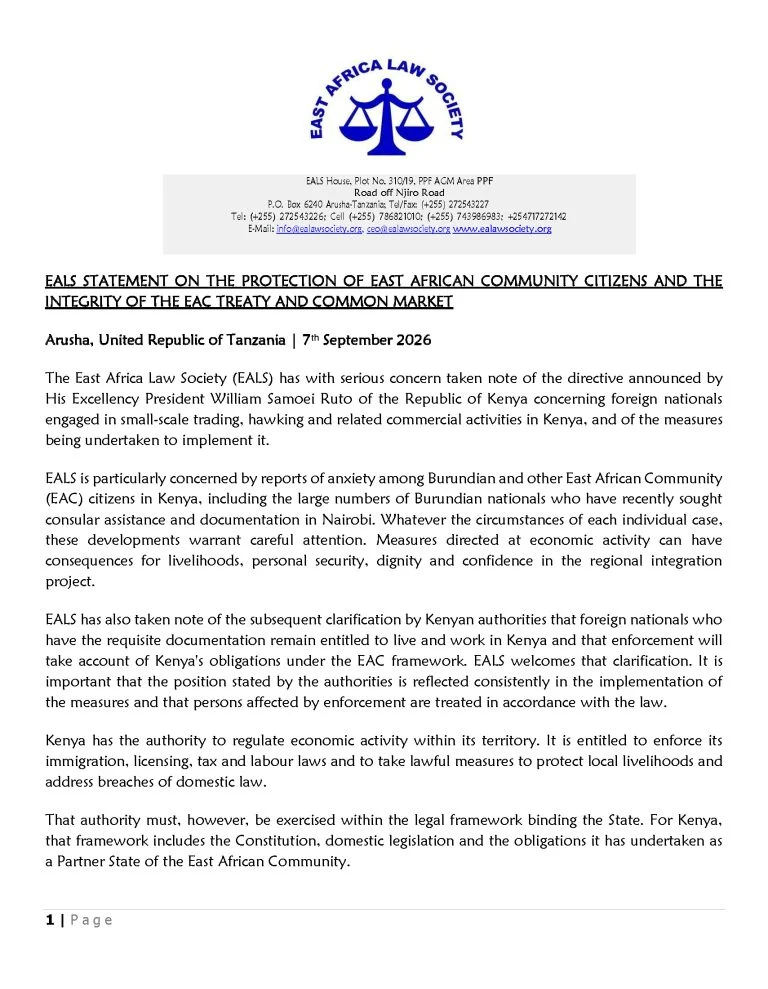
“It is important that the position stated by the authorities is reflected consistently in the implementation of the measures and that persons affected by enforcement are treated in accordance with the law,” EALS said.
The lawyers’ body, however, recognised Kenya’s right to regulate economic activities within its borders.
According to EALS, Kenya is entitled to enforce its immigration, licensing, taxation and labour laws and to take lawful measures aimed at protecting local livelihoods and addressing violations of domestic law.
Also Read: Ruto assents to 4 bills in major governance and legal reforms
The society cautioned, however, that such powers must be exercised within the legal framework binding Kenya as an EAC Partner State.
EALS warns against nationality-based enforcement
A key concern raised by EALS is the possibility of nationality becoming the basis for enforcement rather than an individual’s compliance with Kenyan law.
The society said people accused of violating Kenyan laws should be dealt with according to the applicable law and the circumstances of each individual case.
“Nationality should not, in itself, be treated as evidence of illegality,” EALS said.
It argued that the principle was fundamental to the rule of law and essential to maintaining confidence in the EAC Common Market.
What the EAC Treaty provides
EALS pointed to several provisions of the Treaty for the Establishment of the East African Community and the EAC Common Market Protocol, which it said Kenya must take into account when enforcing its laws against citizens of other Partner States.
Article 6 of the EAC Treaty recognises good governance, the rule of law, social justice and the protection of human and peoples’ rights as fundamental principles of the Community.
Article 7 requires Partner States to abide by those principles, while Article 8 requires them to honour their Treaty obligations and avoid measures that could undermine the objectives or implementation of the Treaty.
The Treaty also establishes the Common Market and provides for the free movement of labour, goods, services and capital, as well as rights of establishment, subject to the Common Market Protocol.
EALS further cited Article 104 of the Treaty, which provides for cooperation among Partner States on the free movement of persons, labour and services and rights of establishment and residence.
Under the Common Market Protocol, Partner States are required to observe non-discrimination against nationals of other Partner States on the basis of nationality.
The Protocol also provides for the free movement of citizens of Partner States and covers the movement of workers and the right of establishment.
Article 13, in particular, provides for the right of a national of a Partner State to take up and pursue economic activities as a self-employed person and to establish and manage economic undertakings in another Partner State.
Foreign traders still subject to Kenyan laws
EALS stressed that the EAC framework does not give foreign nationals immunity from Kenyan laws.
The society said citizens of other EAC Partner States operating in Kenya must comply with the country’s immigration, licensing, taxation, labour and other applicable laws.
“Nor do they prevent Kenya from regulating immigration, licensing, taxation, labour standards or economic activities in accordance with its laws,” EALS said.
However, the society maintained that Kenya’s domestic regulations must be applied consistently with the regional obligations it has voluntarily undertaken under the EAC framework.
The statement comes at a time when Kenya is seeking to tighten enforcement against foreign nationals operating businesses without the required permits, licences or documentation, a move that has particularly affected small-scale traders and hawkers.
EALS called for the enforcement process to uphold the rule of law while protecting the integrity of the EAC Common Market and the rights of citizens from Partner States.