Quality remains the leading factor influencing what Kenyan consumers buy, while most households spend between Ksh1,294 and KSh6,472 a month on fast-moving consumer goods (FMCG), a new GeoPoll study has found.
The findings are contained in GeoPoll’s FMCG & Consumer Insights in Africa 2026 report, based on a survey of 2,403 consumers across Kenya, Nigeria and South Africa in August 2026.
GeoPoll found that quality remained the top purchase driver across all 10 FMCG categories studied for the second consecutive year, ranking ahead of price and brand.
The finding suggests consumers are increasingly looking beyond the cheapest option when purchasing everyday products, although affordability remains an important consideration, particularly for staple foods and household care products.
Also Read: Magadi Soda: How Kenya could turn a century-old mineral into an industrial powerhouse
Kenya recorded the lowest common monthly FMCG spending band among the three countries surveyed. The most common spending range for Kenyan consumers was Ksh1,294 to Ksh6,472, compared with Ksh6,472 to Ksh12,943 in Nigeria and Ksh12,943 to Ksh25,886 in South Africa.
The dollar figures in the GeoPoll report were converted using an exchange rate of approximately Ksh129.43 to the US dollar.
The spending pattern highlights the importance of affordability, pricing and pack sizes for brands targeting the Kenyan market.
The study also found that informal retail remains a major part of consumer purchasing behaviour across Africa.
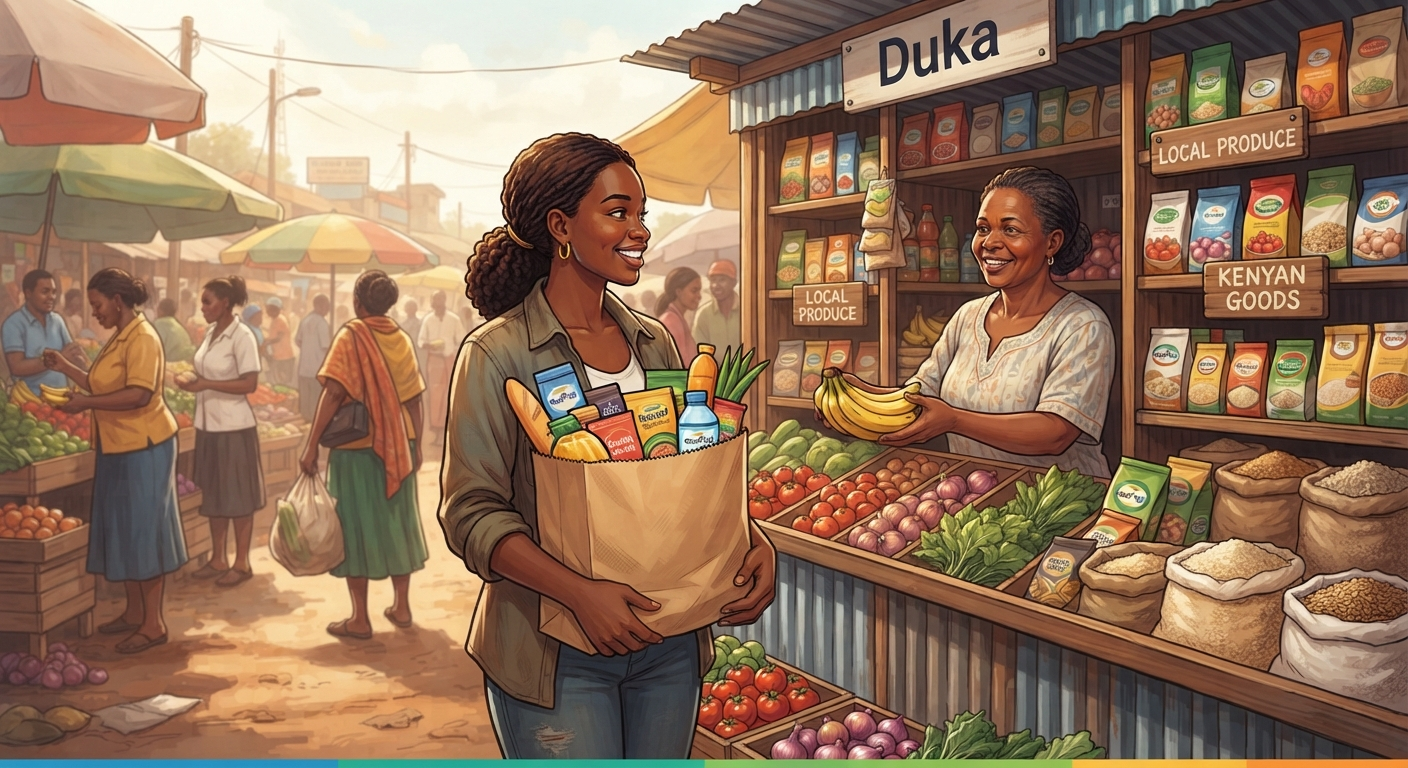
While supermarkets remain the leading retail channel overall, shops, dukas, kiosks and open-air markets continue to play a significant role, particularly in fresh and staple food categories.
Also Read: Ruto unveils Ksh12bn Mombasa SEZ project targeting 10,000 jobs
For fresh and chilled foods, marketplaces and supermarkets each accounted for 32 per cent of purchases.
Local production is also emerging as an important consideration. Across the three markets, 49 per cent of consumers said it was “very important” that products be made in Africa or in their own country, while another 18 per cent said it was “somewhat important”.
Counterfeit products remain another challenge. Sixty per cent of consumers said they always check whether a product is genuine before buying, while 16 per cent said they do so often.
Despite this vigilance, 30 per cent admitted to knowingly buying a counterfeit product at some point.
The findings point to a Kenyan FMCG market where quality, affordability, local production and trust are increasingly shaping consumer choices.